Roof Leak Repair in Greenville, SC
Water coming through your ceiling? One call connects you with an independent roofing contractor working in Greenville — for emergency tarping, proper leak detection, flashing repairs and storm damage. Tell us what you are seeing and we will point you at someone who can deal with it.
Greenville SC Roofing Pros is a referral service. We connect you with local roofing contractors — we do not carry out the repair ourselves.
- Greenville & Greenville County
- Active leaks prioritised
- Verify any licence before hiring
What to do about a roof leak right now
If water is actively coming into your home, the order of operations matters. Protect the inside first, limit the damage second, and get the roof looked at third — in that order.
- Move what can be damaged and catch the water.
Buckets under the drip, furniture and electronics out of the way, towels down. Water finds the lowest point, so check the room below as well.
- If the ceiling is bulging, relieve it.
A sagging, heavy patch of drywall is holding trapped water. Puncturing the lowest point of the bulge with a screwdriver into a bucket drains it in a controlled way. Left alone, that section can come down all at once. Keep clear of light fittings and switch off the circuit if water is anywhere near them.
- Photograph everything before you clean up.
Wide shots of the room, close-ups of the stain, the time and date, and the weather outside. If you later make a claim for storm damage, this is the evidence that the damage was sudden rather than gradual.
- Call a roofer rather than going up yourself.
A wet roof is the most common way homeowners get seriously hurt doing their own repairs, and a leak you can see from inside is rarely where the water is actually entering.
When a roof leak is an emergency
Treat it as urgent and call straight away if any of these apply:
- Water is running, not dripping
- The ceiling is sagging or bulging
- Water is near light fittings, sockets or the consumer unit
- You can see daylight through the roof from inside the attic
- A tree limb or debris has hit the roof
- Shingles are on the lawn after a storm
What can usually wait until business hours
- An old, dry, unchanged stain on a ceiling
- A slow drip that only appears in heavy, wind-driven rain
- Damp in the attic with no water entering living space
- Granules in the gutters with no interior symptoms
None of these are harmless — they just do not usually justify an after-hours call-out rate. Get them looked at, but on a normal appointment.
Roof leak services we connect you with
Seven of the most common reasons Greenville homeowners call a roofer. Each page covers what the problem looks like, how it is repaired and what to ask before you hire.
Emergency Roof Leak Repair
Water coming in right now? Emergency tarping, dry-in and same-visit stabilisation to stop the damage spreading.
Read moreStorm Damage Roof Leak Repair
Leaks that started after wind, hail or a summer thunderstorm — including documentation for an insurance claim.
Read moreRoof Leak Detection
Finding where water actually gets in, which is rarely directly above the stain on your ceiling.
Read moreChimney & Flashing Leak Repair
Step flashing, counter-flashing, crickets and chimney crowns — the single most common source of roof leaks.
Read moreFlat & Low-Slope Roof Leak Repair
Ponding water, split seams and failed penetrations on TPO, EPDM and modified bitumen low-slope roofs.
Read moreSkylight Leak Repair
Failed seals, cracked curbs and bad flashing kits — plus telling a real leak apart from condensation.
Read moreRoof Shingle Repair
Lifted, cracked, missing and wind-creased shingles, nail pops and exposed fasteners.
Read moreRoof leak repair across Greenville and Greenville County
Greenville SC Roofing Pros is a referral service for people in Greenville who have water coming into a building and need a roofer. You call one number, describe what is happening, and we connect you with an independent roofing contractor covering your area. The contractor handles the inspection, the quote, the work and any warranty — we handle getting you to them quickly.
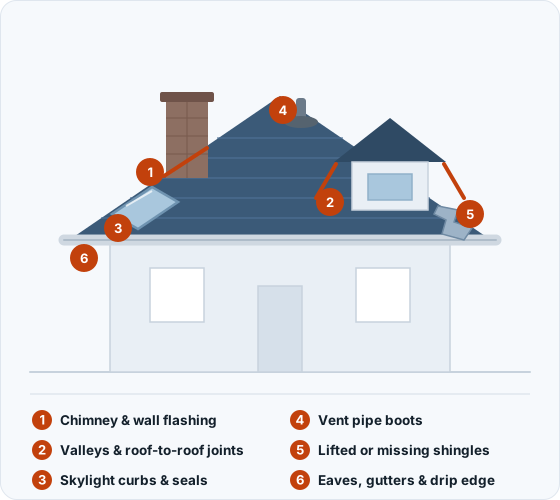
Most of the calls that come in fall into a small number of recognisable patterns. A chimney that has leaked quietly for two winters and finally shows on the dining room ceiling. A pipe boot that cracked in the sun and only leaks in a hard, straight-down rain. A valley that fills with pine needles every autumn and backs water up under the shingles. A skylight that was flashed badly when it was installed fifteen years ago. These are different problems with different fixes, which is why the site has a page for each of the main ones rather than one vague “roof repair” page.
If you are not sure which of those describes your situation, that is normal and it is not a problem. Call and describe what you can see — where the stain is, when it appears, what the weather was doing. That is usually enough for a roofer to form a working theory before they arrive.
What one call covers
- Active leaks and emergency stabilisation
- Tracing a leak back to its real source
- Flashing, valleys, boots, skylights and chimneys
- Wind and hail damage after a storm
- Low-slope and flat sections over porches and additions
- Repairs to asphalt shingle, metal and tile roofs
- Houses, rental property and small commercial buildings
Not sure it is the roof at all? Condensation, a failed bathroom fan duct, a plumbing vent and an air-conditioning condensate line all mimic roof leaks. A proper leak detection visit rules those out instead of guessing.
Why roofs leak in Greenville
Greenville gets roughly 50 inches of rain in an average year, and most of it arrives in bursts rather than drizzle. That pattern is hard on the details of a roof rather than on the field of it.
Heavy summer rain, concentrated into short storms
July is the month with the most wet days here, and summer storms in the Upstate tend to dump water quickly. A roof detail that handles light rain perfectly well — a slightly short piece of step flashing, a valley narrowed by debris, a nail that has backed out a quarter of an inch — will leak under that kind of volume and then stop as soon as the rain eases. That is why so many Greenville leaks are intermittent, and why homeowners often convince themselves a problem has fixed itself.
Severe thunderstorms with wind and hail
Severe thunderstorm warnings issued for the Greenville area routinely reference wind gusts around 60 mph and hail up to about quarter size. Wind at that speed does not usually strip a roof — it lifts and creases shingles along the edges and ridges, breaks the self-seal strip, and leaves a roof that looks intact from the ground but is no longer sealed down. Hail bruises the mat under the granules. Both failures leak later, which is why a leak appearing weeks after a storm is still plausibly storm damage.
Remnants of tropical systems
The Upstate sits far enough inland to escape the worst of coastal hurricanes but close enough to catch their remains: long periods of wind-driven rain from an unusual direction. Water that normally runs down a slope instead gets pushed sideways and uphill, under shingle courses and behind flashing that was only ever designed to shed water moving downward.
Tree cover
Mature oaks and pines are one of the best things about neighbourhoods like Alta Vista, Gower Estates and Botany Woods, and one of the hardest things on a roof. Needles and leaves pack into valleys and behind chimneys, hold moisture against the covering, and dam water back under the shingles. Overhanging limbs abrade granules every time the wind blows. Shaded north slopes stay damp, grow moss and algae, and age noticeably faster than the sunny side of the same roof.
Temperature swing
Hot, humid summers and cold snaps in winter move roofing materials constantly. Sealants harden and crack, rubber pipe boots split, metal flashing expands and contracts against masonry until the joint opens up. The occasional Upstate ice storm adds weight and can force water back up under the eaves as ice melts and refreezes. Few roofs fail all at once here. They fail one detail at a time.
Age and the roofs we actually have
A lot of Greenville’s housing stock sits in the window where roof failures cluster: homes built from the 1960s through the 1990s across the east-side neighbourhoods, and much older homes in the downtown historic districts where the roof may be on its third or fourth covering and the decking underneath has been patched repeatedly. A roof does not have to be in bad condition to leak — it only has to have one bad detail.
Common causes of roof leaks, and what each one looks like
Most leaks we hear described on the phone come down to one of these. Matching your symptom to a likely cause will not fix it, but it does help you ask a contractor better questions.
| Likely cause | What you tend to notice | Usual repair approach |
|---|---|---|
| Failed flashing at a chimney or wall | Stain on a ceiling or wall near the chimney breast; worse in wind-driven rain; often appears in the same spot every year. | Strip and replace step and counter-flashing, rebuild the chimney cricket if there is none. More on flashing repair. |
| Cracked or slipped pipe boot | A small, very localised drip in a bathroom or kitchen ceiling; only in heavy straight-down rain; a visible split in the rubber collar around a vent pipe. | Replace the boot, or fit a collar over the existing one where the flashing base is still sound. |
| Debris-packed or poorly lined valley | Leak along an internal corner of the house where two roof planes meet; worse in autumn; gutters full of needles. | Clear, inspect the valley lining, replace open-valley metal or re-lay the shingle weave. |
| Wind-lifted or missing shingles | Shingles or tabs in the garden after a storm; a horizontal crease across shingles visible from the ground; leak starting days or weeks later. | Replace the damaged courses and re-seal the surrounding area. More on shingle repair. |
| Skylight seal or curb failure | Drip from the inside edge of the skylight shaft; staining down one side of the light well. | Re-flash the curb, replace the seal or gasket, and check it is not simply condensation. More on skylight leaks. |
| Ponding on a low-slope section | Standing water that is still there two days after rain on a porch, addition or garage roof; blistering or split seams in the membrane. | Repair the seam or penetration, and correct drainage or add a taper where possible. More on flat roof leaks. |
| Exposed or backed-out fasteners | Rust streaks on a metal roof; tiny, scattered drips rather than one source. | Replace fasteners with oversize gasketed screws and seal the penetrations. |
| Ice damming at the eaves | Staining at the top of exterior walls after a cold snap; icicles along the gutter line. | Address attic insulation and ventilation as well as the roof covering — the roof is the symptom here, not the cause. |
If none of these match, that is worth knowing too. Leaks that persist in dry weather, appear only when the air conditioning runs, or show up as a damp ring with no drip are often not roof leaks at all. Tell whoever you speak to — the first job of a good leak detection visit is confirming that the roof is actually responsible.
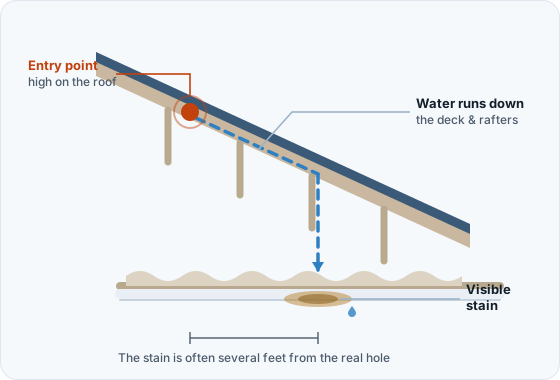
The hole is almost never above the stain
This single fact explains most of the frustration homeowners have with roof leaks, and most of the repairs that do not work. Water enters the roof at one point, meets the underside of the deck, and then runs. It follows the slope of the deck, tracks along a rafter, soaks into felt, and drops only when something stops it — a nail point, a joist, a seam in the insulation, the back of a ceiling fixture.
By the time it reaches drywall, it can be several feet away horizontally from the place it came in, and it is always lower. On a shallow pitch with a long rafter run, that distance can be most of a room. Sealing the roof directly above a ceiling stain is a coin flip, and it is why “we patched it and it still leaks” is such a common second phone call.
Doing it properly means working backwards: into the attic with a light during or just after rain, following the wet trail uphill to where it starts, and only then going onto the roof to look at that specific detail. That is the whole method behind roof leak detection, and it is worth paying for on a leak that has already been “fixed” once.
How our referral service works
We think you should know exactly what happens when you dial the number, so here it is in plain terms.
- You call and describe the problem.
Where the water is showing, how long it has been happening, what the weather was doing, and the type of building. The more specific you are, the better the match.
- We match you to a contractor covering your area.
Matching is based on where you are, what kind of roof you have, and who is available. An active leak in a two-storey house with a steep slate roof is a different call-out from a flat porch roof.
- You deal with the contractor directly from that point.
They arrange the visit, inspect, explain what they found and give you a price. You decide whether to go ahead. There is no obligation to accept a quote, and you are free to get others.
- The contractor does the work and stands behind it.
The contract is between you and them. Any warranty, guarantee, insurance and licence belongs to them. We are not a party to the job.
What happens when you call
Expect a short, practical conversation rather than a sales pitch. You will usually be asked:
- Is water coming in right now?
- What is the address, and is it a house or a commercial building?
- How many storeys, and what is the roof covering?
- Where is the stain, and does it appear in every rain or only some?
- Has anyone worked on the roof before?
- Is this going through insurance?
You are not obliged to give any information you are uncomfortable with, and you will not be asked for payment details by us — we never take payment for roofing work, because we never do roofing work.
The local roofers we connect you with
Every repair arranged through this site is carried out by an independent roofing contractor, not by Greenville SC Roofing Pros. We want to be straightforward about that, because the alternative — implying that a referral service has crews, trucks, decades of experience and a workmanship warranty — is the thing that gives this industry a bad name.
What that means in practice is that credentials belong to the contractor, and you should ask them about their credentials directly. Contractors in a referral network may be licensed, may be insured, may hold manufacturer certifications and may offer their own workmanship warranty — but those vary by company, and we are not going to claim a blanket standard we cannot verify for every provider on every job.
The three things worth checking before anyone starts work
- Licence.
South Carolina regulates residential contractors through the Department of Labor, Licensing and Regulation. Residential work under $10,000 falls under a Residential Specialty registration covering roofing above the roof deck; work over that threshold, and commercial roofing, requires a general contractor licence with a roofing classification. Ask which they hold and look it up.
- Insurance.
Ask for a current certificate showing general liability and workers’ compensation. If someone is hurt on your roof and the contractor has no cover, that becomes your problem.
- A written scope.
What is being repaired, what materials, what happens to the price if rotten decking is found underneath, and what warranty is offered on the workmanship. Verbal agreements on roofing jobs go wrong in predictable ways.
What we do not claim
You will not find star ratings, review counts, awards, or “20 years of experience” badges on this site attached to our name. We have not performed any roofing work, so we have not earned any of those. Where a specific contractor’s credentials are relevant to your job, ask them for the detail and verify it independently.
If another referral site shows you a shiny aggregate rating with no named provider behind it, ask yourself whose rating it is.
Good questions to ask the contractor
- “What is your SC licence number and classification?”
- “Can you send a certificate of insurance?”
- “Will you photograph what you find before you repair it?”
- “Is the quote for the repair only, or does it assume no rot underneath?”
- “What warranty do you give on this workmanship, in writing?”
- “Who is actually on my roof — your crew or a subcontractor?”
Greenville neighbourhoods we serve
Roof problems cluster by neighbourhood here, because houses on the same street tend to be of the same age and built the same way. We have written a page for each of the areas we get the most calls from, covering what the roofs are actually like there and what tends to go wrong.
Historic districts
Older homes near downtown where original roof details, chimney flashing and aged decking drive most leaks.
Established & premium neighbourhoods
Larger homes with complex rooflines, dormers, skylights and heavy tree cover.
High-density residential areas
Ranch and two-storey homes from the 1960s onward, where roofs often age together street by street.
What actually drives the cost of a roof leak repair
We deliberately do not publish prices. We are not the contractor, prices move with materials and labour, and a number invented for a web page is worse than no number at all. What we can do is tell you what a quote is made of, so you can read one properly.
- Access and safety. Single-storey walkable pitch versus a steep two- or three-storey roof that needs staging or harnesses. This is often the biggest single variable.
- How many problems there are. One cracked pipe boot is a different job from a roof with three unrelated failures found during the inspection.
- Whether the deck is sound. Rotten sheathing under the covering has to be cut out and replaced, and it is usually only discovered once the roof is opened. Ask how this is priced before work starts.
- The roof covering. Patching architectural asphalt shingle is routine. Slate, clay tile, standing-seam metal and older built-up roofs need different skills and materials.
- Matching. On an older roof, finding shingles that match in colour and profile may be impossible, which changes the repair strategy.
- Emergency versus scheduled. A call-out at 10pm in a storm costs more than a Tuesday morning appointment. That is not opportunism; it is overtime and risk.
- Interior work. Most roofers repair the roof, not your ceiling. Drywall, paint and insulation are often a separate trade and a separate bill.
Roof leaks, insurance and storm claims
If your leak started with a specific weather event, the sequence matters. Document the damage before anything is touched, report it to your insurer promptly, and let the adjuster see it. A contractor can usually provide a written scope and photographs that support the claim, and many are used to working alongside adjusters.
Be realistic about what is covered. Insurers generally treat sudden accidental damage from wind, hail or impact differently from deterioration, and a leak that has been quietly staining a ceiling for three years is hard to present as sudden. Our storm damage roof leak repair page goes through the documentation step by step.
Be careful with storm-chasing crews
After a significant hail or wind event in the Upstate, out-of-state crews appear quickly. Some are perfectly legitimate. Be cautious about anyone who knocks on your door unprompted, pressures you to sign immediately, offers to “cover your deductible”, or asks for a large deposit before any work. Check the licence, check the insurance, and do not sign anything that assigns your insurance benefits away unless you fully understand it.
Roof leak questions Greenville homeowners ask
How quickly can someone look at my roof leak in Greenville?
It depends on who is free when you call. One phone call puts you in touch with an independent roofing contractor serving the Greenville area, and that contractor tells you directly what their next available slot is. Active leaks during or straight after a storm are normally treated as higher priority than a stain that has been there for months, but scheduling, pricing and availability are set by the contractor, not by us. If water is coming in now, say so on the call — that is what moves a job up a queue.
Can a roof leak be repaired in the rain?
A permanent repair usually cannot be done in heavy rain, because asphalt shingles, sealants and most flashing materials need a dry, clean surface to bond properly. What can be done in the wet is stabilisation: a tarp or peel-and-stick membrane over the affected slope to stop more water entering, plus interior protection. That is the normal first visit for an emergency roof leak, with the permanent repair scheduled once the roof is dry.
Why is the stain on my ceiling not directly under the hole?
Because water travels. It enters at a gap in the roof covering, runs down the underside of the roof deck or along a rafter, and only drops when it reaches an obstruction — a joist, a nail, a light fixture, a run of insulation. The stain you can see is frequently several feet away from, and almost always lower than, the real entry point. This is the main reason a proper roof leak detection visit starts in the attic rather than on the roof.
Do I need a full roof replacement or just a repair?
A repair is usually reasonable when the roof covering is still in sound condition overall and the leak is traceable to one failed detail — a length of step flashing, a cracked pipe boot, a handful of wind-damaged shingles, a skylight seal. Replacement becomes the better value when shingles are brittle and losing granules across the whole roof, when there are leaks in several unrelated places at once, or when the deck underneath has rotted over a wide area. An honest contractor should show you photographs of what they found and explain which situation you are in. Get a second opinion if a replacement is recommended without evidence.
Is roof leak damage covered by homeowners insurance in South Carolina?
Policies differ, but the general pattern is that sudden, accidental damage from a named peril — wind lifting shingles, hail bruising the roof covering, a tree limb punching through the deck — is more likely to be covered, while damage attributed to age, wear or deferred maintenance is usually excluded. Repeated leaking that has been ignored can be treated as a maintenance issue even when it started with a storm. If a specific weather event caused your leak, photograph everything before anything is moved or repaired, and read more on our storm damage roof leak repair page. Your insurer decides coverage, not the roofer and not us.
How much does roof leak repair cost in Greenville?
We do not quote prices, because we are not the company doing the work and any number we published would be a guess. What drives the price is well understood, though: how easy the roof is to get onto and walk safely, the pitch, how many storeys, whether the leak is one detail or several, whether decking or framing under the covering has rotted and needs replacing, the roof covering material, and whether the visit is an emergency call-out. Ask the contractor for a written scope before work starts, and ask specifically what happens to the price if they open the roof up and find rotten decking.
Will a roofer put a tarp on my roof the same day?
Often yes, if a crew is available and the weather allows anyone on the roof safely. Tarping is a holding measure, not a repair — it buys time to dry out and schedule proper work. Note that tarps installed on a steep, wet or storm-damaged roof are genuinely dangerous to fit, so a contractor may decline to go up during active lightning or high wind. That is a sign of a careful contractor, not an unhelpful one.
Do I need a permit to repair a roof leak in Greenville County?
Small repairs often do not, while re-roofing and structural work generally do. Building permits in the unincorporated county are handled by Greenville County Codes Enforcement, and properties inside the City of Greenville limits fall under the city instead. Homes in one of the city’s locally designated preservation overlay districts — including Hampton-Pinckney, Colonel Elias Earle and Pettigru — can have an extra design review step for visible exterior changes such as a change of roofing material. The contractor you hire should know which rules apply; confirm it with the relevant authority before material is ordered.
How do I check that a roofing contractor is properly licensed in South Carolina?
South Carolina regulates residential contractors through the Department of Labor, Licensing and Regulation (LLR). Residential jobs under $10,000 fall under a Residential Specialty registration, which covers roofing work above the roof deck only — altering or repairing the deck itself requires a licensed Residential Builder. Residential work over $10,000 and commercial roofing require a general contractor licence carrying a roofing classification. You can look up any contractor’s licence type and status on the LLR website, and you should also ask for a current certificate of general liability and workers’ compensation insurance.
What areas around Greenville do you cover?
The referral network covers the City of Greenville and the surrounding parts of Greenville County. That includes the downtown historic districts, the established east-side neighbourhoods along the Pelham Road and Roper Mountain corridors, the north-side areas at the foot of Paris Mountain, and the Five Forks area toward Simpsonville and Greer. If your street is not listed on the site, call anyway and we will tell you honestly whether we have someone covering it.
Water coming in? Make one call.
Describe the leak and we will connect you with an independent roofing contractor covering Greenville.
Calls may be routed to a participating contractor and we may be compensated for the referral.
Contact Greenville SC Roofing Pros
- Phone
- 123-456-789
- Address
- 872 S Pleasantburg Dr
Greenville, SC 29607
- Service area
- The City of Greenville and surrounding Greenville County, including the downtown historic districts, the east-side neighbourhoods, the Paris Mountain foothills and the Five Forks area.
- What we are
- A referral service. We connect you with independent local roofing contractors and do not perform roofing work ourselves.
Everything you need to reach us is on the contact page, and there is more about how the service operates on our about page.