Emergency Roof Leak Repair in Greenville, SC
If water is running into your house, the goal of the first visit is not a perfect repair — it is stopping the damage getting worse. Call and describe what you are seeing, and we will connect you with an independent roofing contractor covering Greenville.
Greenville SC Roofing Pros connects you with an independent local roofing contractor. We do not carry out roofing work ourselves.
What counts as an emergency roof leak?
A roof leak is an emergency when water is entering the building faster than you can manage it, when it is reaching anything electrical, or when the structure itself is compromised — a bulging ceiling, a hole from a fallen limb, visible daylight through the deck, or a slope that has lost its covering in a storm. Everything else is urgent but schedulable.
The distinction matters because emergency work is priced and performed differently. An emergency call-out buys you stabilisation: tarping or a temporary membrane over the affected area, interior protection, and an assessment. The permanent repair almost always happens on a later visit, once the roof is dry enough to bond materials to.
Call immediately if
- Water is running rather than dripping
- A ceiling is sagging, bulging or discoloured over a wide area
- Water is near light fittings, sockets or an electrical panel
- A tree limb, branch or debris has struck the roof
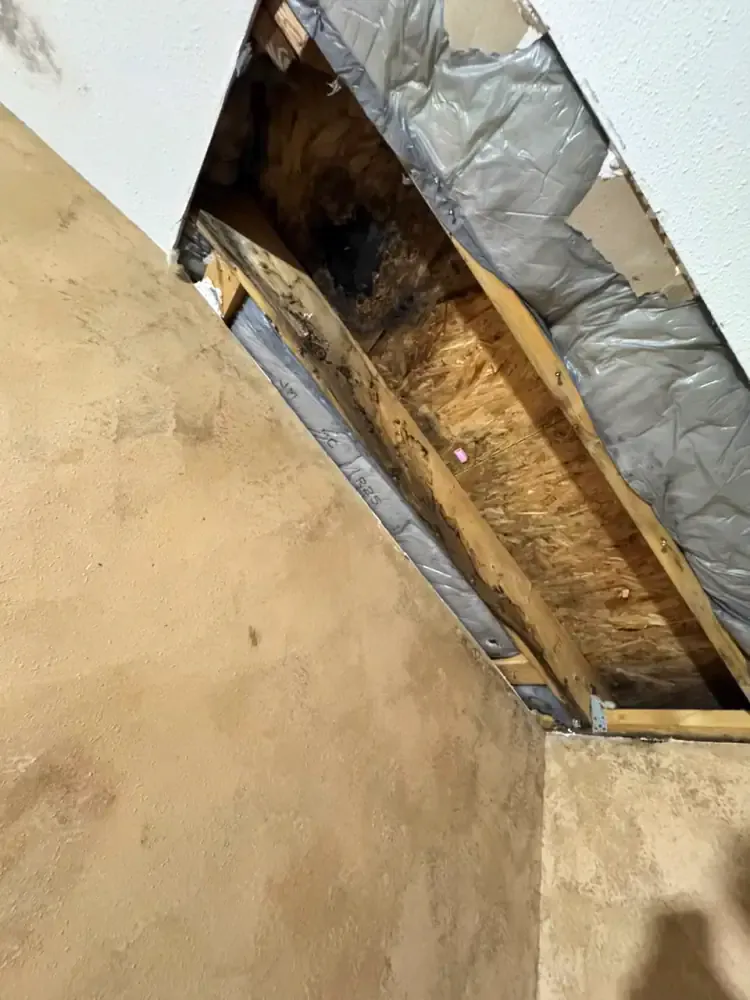
- You can see daylight through the roof deck from inside the attic
- A storm has stripped shingles and more rain is forecast
What to do in the first ten minutes
Before anyone arrives, a few things materially reduce the final repair bill.
- Protect the inside.
Buckets under the drip, furniture and electronics moved clear, towels down. Replace buckets before they overflow — a second soaking of the same carpet is what turns a repair into a replacement.
- Relieve a bulging ceiling deliberately.
A sagging patch of drywall is a bag of water. Push a screwdriver through the lowest point of the bulge, into a bucket, and let it drain in a controlled way. A ceiling that lets go on its own takes light fittings and insulation with it.
- Kill the power to affected circuits.
If water is anywhere near a ceiling light, a fan or a socket, switch that circuit off at the panel rather than testing whether it is fine.
- Photograph and time-stamp everything.
Before you mop up. Wide shots, close-ups, the outside of the house, the weather. This is what an insurance adjuster will want if the cause was a storm.
- Stay off the roof.
Wet shingles are slick, storm-damaged decking can be unsupported underneath, and the leak is rarely where you would look anyway. This is the single most common way homeowners are seriously injured.
What an emergency visit normally involves
A contractor arriving on an active leak is working to a different brief than a scheduled repair. Expect something close to this sequence:
- A safety assessment first. Whether the roof can be walked at all, given weather, pitch, condition and light. A contractor who declines to climb in active lightning or 40 mph gusts is being responsible, not awkward.
- Interior inspection. Usually the attic, to find where water is actually entering and how far it has spread into insulation and framing.
- Stabilisation. A reinforced tarp battened down over the affected slope, or a self-adhering membrane applied directly to the deck where a section of covering is gone. Done properly this is fastened and sealed, not weighted down with bricks.
- Interior protection. Removing saturated insulation that will otherwise hold water against your ceiling for days.
- Documentation. Photographs of the damage and the cause, which matter both for your records and for a claim.
- A plan and a quote for the permanent repair.
A tarp is a holding measure, not a repair
A well-installed tarp buys weeks, not months. Ultraviolet light degrades the material, wind works at the fastenings, and every fastening is itself a hole in your roof. Use the time to get the real repair scheduled rather than treating the tarp as the solution.
Emergency leaks in Greenville specifically
Most emergency calls in the Upstate come in clusters, because the weather that causes them affects a whole area at once. A severe thunderstorm with 60 mph gusts and quarter-size hail does not damage one house; it damages a street. The practical consequence is that after a significant storm, every roofing contractor in Greenville County is fielding calls simultaneously, and response times stretch. Calling early in that window genuinely matters.
The second pattern is wind-driven rain from the remains of tropical systems, which pushes water sideways into details that only ever shed water running downhill. Houses that have never leaked in forty years of ordinary rain leak in those conditions. If that describes your situation, the problem is usually flashing rather than the field of the roof.
Older homes near downtown — the Overbrook, Pettigru and Hampton-Pinckney districts among them — bring an extra wrinkle. Steep pitches make emergency tarping harder and more dangerous, original materials may be difficult to match, and visible exterior changes in a locally designated preservation overlay district can require design review. None of that stops emergency stabilisation, but it does shape the permanent repair.
Whatever the cause, the first step is the same for everyone: get someone who knows roofs to look at it. The fastest route to that is our main roof leak repair service in Greenville, which covers the city and the surrounding county.
What emergency work costs more than scheduled work — and why
We do not publish prices, because the contractor sets them and we would be guessing. But it is fair to explain why an emergency call-out is more expensive than a Tuesday morning appointment:
- It is out-of-hours labour, often at overtime rates
- It is higher risk work — wet, dark, sometimes windy
- It displaces scheduled jobs the contractor has already committed to
- It is usually two visits rather than one: stabilise now, repair properly later
Ask up front whether there is a call-out fee, whether it is credited against the permanent repair, and whether the tarp cost is separate. A contractor who answers those clearly on the phone is usually one who behaves the same way on the invoice.
Emergency roof leak questions
Can a roof leak be repaired while it is still raining?
Stabilised, yes. Permanently repaired, usually not. Shingle sealant, flashing mastic and most patching materials need a dry, clean surface to adhere to, and a repair bonded to a wet deck tends to fail. The standard approach is to tarp or dry-in now and return to do the work properly once the roof has dried.
Should I put a tarp on the roof myself?
We would not advise it. Wet roofs are slippery, storm damage can leave decking unsupported where it looks solid, and tarps catch wind like a sail while you are holding them. If you do nothing else, protect the inside of the house and wait for someone with fall protection.
How long can I leave a tarp on my roof?
Weeks rather than months. Sunlight breaks down the material, wind works the fastenings loose, and each fastening is a penetration through the roof. Treat it as a countdown to the real repair.
Will my insurance pay for emergency tarping?
Many policies include reasonable emergency mitigation costs, on the basis that preventing further damage is in the insurer's interest too. Keep the receipt and the photographs, and tell your insurer promptly. Coverage is your insurer's decision; neither we nor the contractor can promise it.
My ceiling is bulging. Is that dangerous?
Treat it as dangerous. Water is heavy, and a saturated section of drywall can come down without warning taking light fittings with it. Keep people out of the room, switch off the circuit if there is a fixture nearby, and drain it deliberately at the lowest point into a bucket.
Do you charge me for the referral?
No. There is no charge to you for being connected with a contractor. We may be compensated by the contractor for the referral. Anything you pay for the roofing work itself is paid to the contractor under an agreement between you and them.
Water coming in right now?
Call and describe what you are seeing. We will connect you with a roofing contractor covering Greenville and the surrounding county.
Calls may be routed to a participating contractor and we may be compensated for the referral.
Other roof leak services
If the water is under control, these pages cover the specific failures that cause most Greenville leaks.
Storm Damage Roof Leak Repair
Leaks that started after wind, hail or a summer thunderstorm — including documentation for an insurance claim.
Read moreRoof Leak Detection
Finding where water actually gets in, which is rarely directly above the stain on your ceiling.
Read moreChimney & Flashing Leak Repair
Step flashing, counter-flashing, crickets and chimney crowns — the single most common source of roof leaks.
Read moreFlat & Low-Slope Roof Leak Repair
Ponding water, split seams and failed penetrations on TPO, EPDM and modified bitumen low-slope roofs.
Read moreSkylight Leak Repair
Failed seals, cracked curbs and bad flashing kits — plus telling a real leak apart from condensation.
Read moreRoof Shingle Repair
Lifted, cracked, missing and wind-creased shingles, nail pops and exposed fasteners.
Read moreRoof Valley Leak Repair
Where two roof planes meet, water concentrates and debris dams it back under the shingles.
Read moreCommercial Roof Leak Repair
Low-slope commercial roofs, HVAC curbs, drains and the licensing rules that differ from residential work.
Read more