Storm Damage Roof Leak Repair in Greenville, SC
Storm damage does not always leak immediately. A roof can be unsealed by wind in June and only show on a ceiling in August. If your leak started after bad weather, the repair and the paperwork both need handling properly.
Greenville SC Roofing Pros connects you with an independent local roofing contractor. We do not carry out roofing work ourselves.
How do I know if a storm damaged my roof?
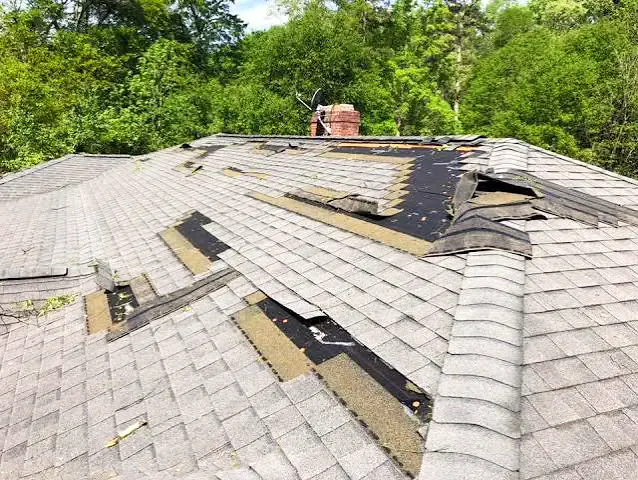
From the ground, you are looking for shingles or tabs in the garden, a horizontal crease across shingle courses, lifted or curled edges along hips and ridges, bent or dented gutters and vents, and granules washed into the gutter outlets. From inside, you are looking for new staining, damp in the attic, or daylight visible through the deck.
What makes storm damage different from ordinary wear is that it is often invisible from the ground while being functionally serious. Wind at the 60 mph gusts commonly cited in severe thunderstorm warnings for the Greenville area does not usually strip a roof bare. It breaks the self-seal strip that bonds each shingle course to the one below. The shingles stay in place and look fine, but they are no longer sealed down — so the next wind-driven rain goes underneath them.
Hail does something similar. Quarter-size hail bruises the asphalt mat beneath the granules without necessarily puncturing anything. The bruise is a weak spot that weathers early. In both cases, a leak appearing weeks after the storm is entirely consistent with the storm having caused it.
Document it before anything is repaired
If there is any chance of an insurance claim, the evidence has to be gathered before the damage is cleaned up or covered. This sequence protects you:
- Photograph the interior damage.
Wide shots showing the room and the affected ceiling, then close-ups. Include something in frame that gives scale.
- Photograph the exterior from the ground.
All four elevations, the gutters, anything on the lawn. Do not climb up for better angles.
- Record the date, time and weather.
A note of when you first saw water, and what the weather was doing, is more useful than people expect months later.
- Keep damaged material.
Shingles that blew off are evidence. Put them somewhere dry rather than in the bin.
- Report it to your insurer promptly.
Most policies require prompt notice. Delay is one of the most common reasons a legitimate claim gets reduced.
- Get emergency mitigation done — and keep the receipt.
Preventing further damage is normally expected of you. See emergency roof leak repair for what that visit involves.
What a storm damage inspection should cover
A thorough inspection looks at considerably more than the leaking area, because a storm affects the whole roof. Expect a contractor to check:
| Area | What they are looking for |
|---|---|
| Shingle field | Creasing, lifted tabs, broken seal strips, missing shingles, hail bruising, granule loss concentrated on exposed slopes |
| Hips and ridges | Displaced ridge caps — the most wind-exposed part of the roof and often the first to fail |
| Flashing | Lifted step and counter-flashing at chimneys and walls, displaced valley metal. See flashing repair |
| Penetrations | Split or displaced pipe boots, damaged vents, satellite mounts, dented turbines |
| Skylights | Cracked glazing, damaged curb flashing, broken seals. See skylight leak repair |
| Low-slope sections | Punctures, lifted seams, debris impact on porch and addition roofs. See flat roof leak repair |
| Gutters and fascia | Dents consistent with hail, separation from the fascia, wind damage to the drip edge |
| Attic | Daylight through the deck, wet sheathing, saturated insulation, staining on rafters |
Ask for the photographs. A contractor who inspects properly will have them, and a written scope backed by images is far more persuasive to an adjuster than a one-line quote.
Storms in the Upstate, and what they do to roofs here
Greenville sits in a part of South Carolina that gets a specific mix of weather, and each component fails roofs in a different way.
Summer thunderstorms. The Upstate's wettest stretch is the summer, and July has the most wet days of any month. These storms are short, intense and often carry damaging gusts. They find details that are marginal rather than destroying details that are sound.
Hail. Severe thunderstorm warnings for the Greenville area commonly cite hail around quarter size. That is enough to bruise asphalt shingles and dent soft metal — gutters, vents, flashing — which is why inspectors check metal components to corroborate a hail claim.
Remnants of tropical systems. Far enough inland to avoid the worst, close enough to catch hours of wind-driven rain from an unusual direction. This is the weather that exposes flashing installed to shed water in one direction only.
Winter ice. Less frequent, but ice adds weight, and freeze-thaw cycling opens up sealant joints and lifts the edges of a roof covering over time.
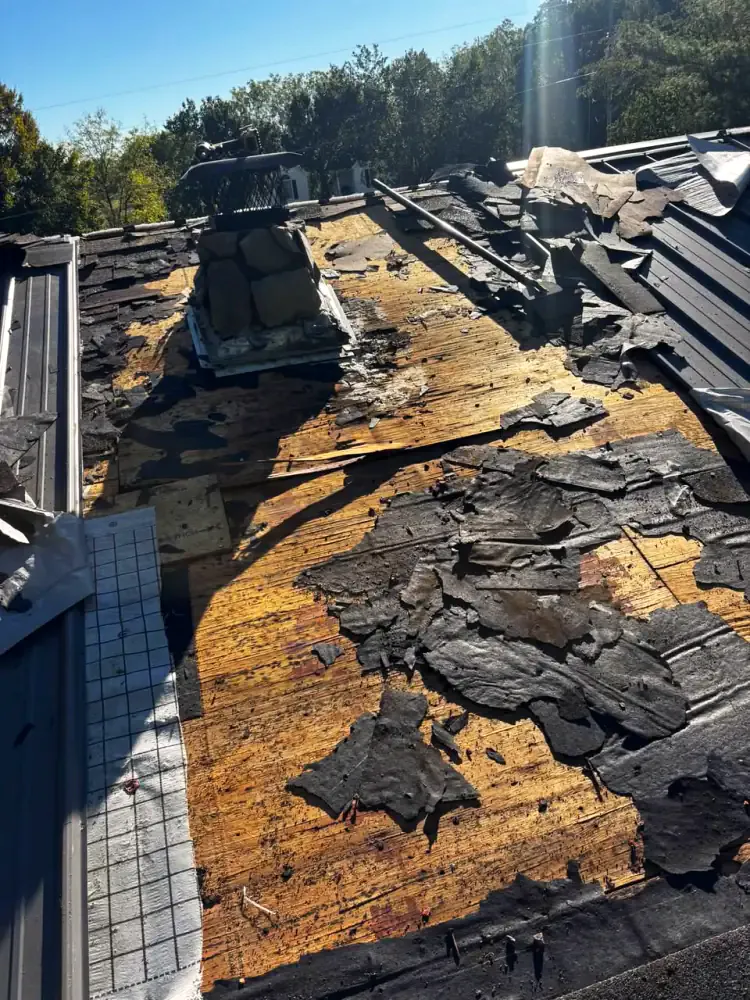
Tree cover compounds all of it. In the heavily wooded east-side neighbourhoods — Foxcroft, Botany Woods and Spring Forest among them — the usual storm damage is not the wind itself but what the wind throws: limbs scraping granules off, debris packing into valleys, branches puncturing low-slope porch roofs. If you want the broader picture of how we handle roof leak repair across Greenville, that is on the main page.
Dealing with contractors after a storm
Door-knockers after a hail event
Significant hail in the Upstate brings crews from out of state within days. Some are legitimate businesses chasing legitimate work. Some are not. The warning signs are consistent: pressure to sign on the spot, a large deposit demanded before any work, an offer to “waive” or “cover” your deductible (which is generally improper), vague company details, and paperwork that assigns your insurance benefits to them.
Slow down. Verify the South Carolina licence through the Department of Labor, Licensing and Regulation, ask for a certificate of insurance, and do not sign anything you have not read.
What is usually covered, and what usually is not
Policies vary and your insurer decides, but the general pattern is consistent: sudden accidental damage from a named peril such as wind, hail or falling impact is more likely to be covered, while deterioration, age and deferred maintenance are usually excluded. Some policies settle roof claims on actual cash value rather than replacement cost, which means depreciation comes off the payout. Others carry a separate, higher wind and hail deductible. It is worth reading those two clauses in your own policy before you are relying on them.
A common grey area is a roof that was already near the end of its life when the storm hit. Insurers often argue the damage is wear; homeowners argue it is the storm. Photographs, dated weather records and a contractor's written assessment are what move that argument.
Storm damage questions
How long after a storm can I claim for roof damage?
Most policies require prompt notice, and some set an outer limit. The practical answer is to report it as soon as you are aware of damage. Delay gives an insurer grounds to argue the damage came from something else, or that further damage could have been prevented.
My roof looks fine from the ground but it leaks after the storm. Is that normal?
Very. The most common wind damage is a broken seal strip between shingle courses, which leaves shingles lying flat and looking perfect while no longer being bonded down. Wind-driven rain then gets underneath. A roof can be functionally compromised and visually unchanged.
Can hail damage a roof without breaking anything?
Yes. Hail bruises the asphalt mat under the granules. The bruise is a weakened spot that weathers early and leaks later. Inspectors often look at soft metal — gutters, vents, flashing — for dents, because those corroborate that hail of a damaging size actually fell on the property.
Should I let a roofer handle my insurance claim for me?
A contractor can legitimately inspect, document and provide a written scope, and most are used to meeting adjusters on site. Be more careful about agreements that hand over control of the claim itself. Read anything described as an assignment of benefits carefully before signing it.
Will repairing storm damage mean replacing the whole roof?
Not necessarily. Localised wind damage to a few courses is a repair. Widespread hail bruising across every slope is usually a replacement. The honest answer depends on the extent, the age of the covering and whether matching material is still available, and it should be supported by photographs.
What if the storm damage is on a neighbour's tree that fell on my roof?
That is a question for your insurer rather than your roofer, and the answer often turns on negligence — whether the tree was visibly dead or diseased beforehand. Document the tree as well as the roof damage, and get the roof stabilised regardless while the liability question is settled.
Leaking after the storm?
Get it inspected and documented properly. One call connects you with a roofing contractor working in Greenville County.
Calls may be routed to a participating contractor and we may be compensated for the referral.
Other roof leak services
Storm damage usually shows up at one of these specific details first.
Emergency Roof Leak Repair
Water coming in right now? Emergency tarping, dry-in and same-visit stabilisation to stop the damage spreading.
Read moreRoof Leak Detection
Finding where water actually gets in, which is rarely directly above the stain on your ceiling.
Read moreChimney & Flashing Leak Repair
Step flashing, counter-flashing, crickets and chimney crowns — the single most common source of roof leaks.
Read moreFlat & Low-Slope Roof Leak Repair
Ponding water, split seams and failed penetrations on TPO, EPDM and modified bitumen low-slope roofs.
Read moreSkylight Leak Repair
Failed seals, cracked curbs and bad flashing kits — plus telling a real leak apart from condensation.
Read moreRoof Shingle Repair
Lifted, cracked, missing and wind-creased shingles, nail pops and exposed fasteners.
Read moreRoof Valley Leak Repair
Where two roof planes meet, water concentrates and debris dams it back under the shingles.
Read moreCommercial Roof Leak Repair
Low-slope commercial roofs, HVAC curbs, drains and the licensing rules that differ from residential work.
Read more