Flat & Low-Slope Roof Leak Repair in Greenville, SC
Low-slope roofs do not shed water — they hold it until it drains. That changes everything about how they are built, how they fail and how they have to be repaired.
Greenville SC Roofing Pros connects you with an independent local roofing contractor. We do not carry out roofing work ourselves.
Why do flat roofs leak differently from sloped roofs?
A pitched roof sheds water by gravity, and its covering is a series of overlapping pieces. A low-slope roof is a continuous waterproof membrane, and water sits on it until it finds a drain. There is no margin for a lap that points the wrong way, because water is not running past — it is standing on top.
That has two practical consequences. First, almost every low-slope leak happens at a seam, an edge or a penetration rather than in the middle of the membrane. Second, water that gets through spreads sideways between the membrane and the deck, so the interior stain can be a very long way from the actual breach. Finding the entry point on a flat roof is often harder than repairing it.
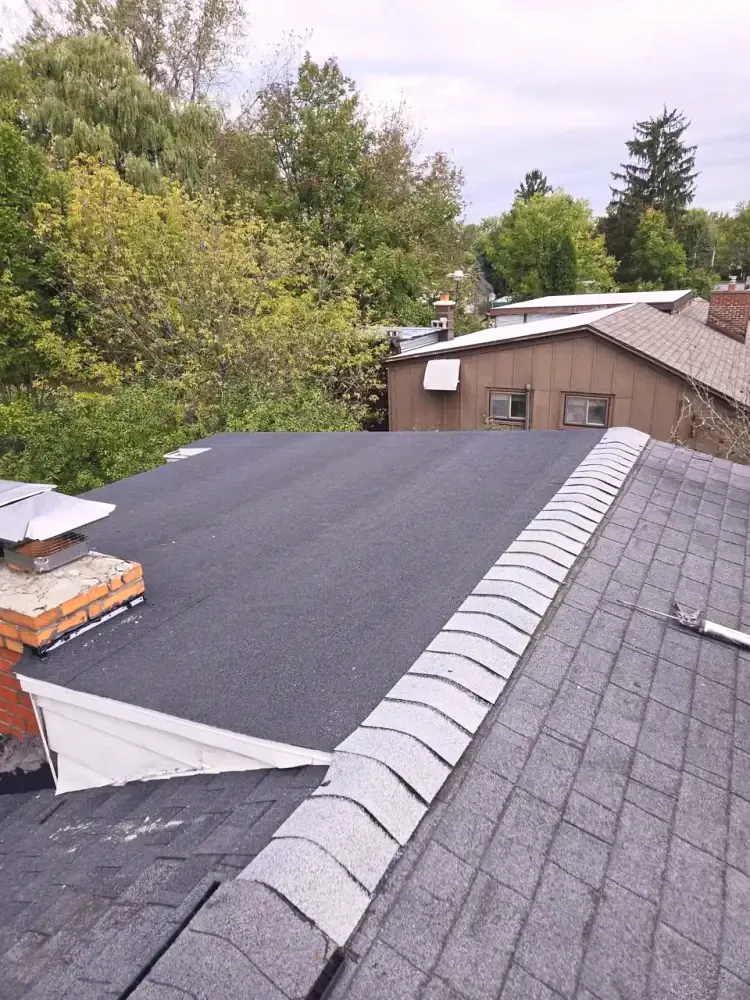
In residential Greenville this mostly means porch roofs, garage roofs, additions, dormer tops and the flat sections above bay windows — small areas, often added later, and frequently the part of the roof that received the least care.
The main low-slope systems and how each fails
| System | Where it usually fails | Typical repair |
|---|---|---|
| TPO (white single-ply) | Seams, especially where they were under-welded on installation; punctures from dropped tools or debris | Heat-welded patch over a cleaned, prepared area |
| EPDM (black rubber) | Seams and flashing details; shrinkage pulling the membrane away from edges and curbs over time | Cleaned and primed, then a cured or uncured rubber patch bonded over it |
| Modified bitumen (torch-down) | Blisters, open laps, and splits where the sheet has aged and lost flexibility | Cut, dry out, and heat-apply a new sheet over the prepared area |
| Built-up roofing (tar and gravel) | Alligatored, dried-out bitumen; failed flashing at edges and curbs | Localised rebuilding of plies, or recovering if widespread |
| Rolled asphalt | Open laps and brittleness — a short-life material common on older porch roofs | Usually replacement rather than repair |
| Spray foam or coating systems | Thin or missing coating; punctures; failure at transitions | Re-coat, after confirming the substrate underneath is dry |
The big one: trapped water
If water has been getting under the membrane for a while, the insulation and deck beneath are wet. Patching the top without addressing that seals the water in, where it keeps rotting the deck and keeps showing up inside. A proper repair establishes how far the wet area extends — by probing, core sampling or infrared survey — and removes the saturated material. A repair that skips this step is why flat roofs get “fixed” three times.
Ponding water
Water still sitting on a low-slope roof 48 hours after rain stopped is called ponding, and it is a problem rather than a cosmetic annoyance. It adds sustained weight, accelerates the breakdown of most membranes, collects debris which holds yet more water, and turns a minor seam defect into a continuous leak because there is always water sitting on it.
Ponding is usually caused by one of four things: inadequate fall designed in originally, a deck that has deflected under load over the years, blocked drains or scuppers, or an insulation layer that has compressed in places. The fix depends on which — cleaning drains is easy, adding tapered insulation to re-establish fall is a bigger job. Either way, repairing a membrane under standing water without addressing the drainage means the repair sits permanently submerged.
Signs a low-slope roof needs attention
- Standing water two days after rain
- Blisters or bubbles in the membrane
- Seams you can lift at the edge with a fingernail
- The membrane feeling soft or spongy underfoot — wet insulation below
- Splits or crazing, particularly on older bitumen
- Membrane pulled tight at corners and curbs, or lifting away from the edge metal
- Debris packed around drains and scuppers
- Interior staining a long way from any obvious defect
Low-slope roofs in Greenville
Greenville's roughly 50 inches of annual rainfall arrives mostly in heavy summer bursts, and that pattern is particularly hard on low-slope roofs. A membrane that drains adequately in steady rain can be overwhelmed when an inch falls in an hour, and water backs up over edge details that were never meant to be submerged.
Residentially, the most common low-slope leaks here are on porch and addition roofs. Older houses in the downtown districts frequently have a flat or near-flat porch roof — East Park, Pettigru and Overbrook all have plenty of them — often finished in rolled asphalt or an aged built-up system that has outlived its design life. Those roofs are small, easy to overlook, and sit directly above a ceiling you walk under every day.
The other recurring pattern is the 1960s–1990s addition. Plenty of homes in Spring Forest, Gower Estates and Cherrydale have a den, sunroom or carport added with a low-slope roof tied into the main pitched roof. That tie-in — where the low-slope membrane meets the shingles above — is a classic leak point, and it needs both a flashing detail and a membrane detail to work together. It is often diagnosed alongside flashing repairs.
Small commercial buildings across Greenville County are predominantly low-slope, and the same principles apply at larger scale with more penetrations: HVAC curbs, vents, conduit and drains. For either kind of building, our roof leak repair service in Greenville, SC is the place to start.
Repair, recover or replace?
Three legitimate options, and the right one depends on how much of the system has failed.
- Repair makes sense when the membrane is generally sound, there are one or two defined defects, and the insulation underneath is dry. Patch the breach, confirm drainage, move on.
- Recover — installing a new membrane over the existing one — can be cost-effective when the existing system is intact but at the end of its life, and the structure can take the additional weight. It is not appropriate over wet insulation, and there are limits on how many layers a roof may carry.
- Replace becomes the honest answer when insulation is saturated across a wide area, the deck has deteriorated, or the membrane has failed in multiple unrelated places. Tearing off also allows the fall to be corrected with tapered insulation, which solves ponding permanently rather than annually.
A contractor recommending replacement should be able to show you why — moisture readings, core samples or thermal images, not just an opinion. Ask for that evidence.
Flat and low-slope roof questions
Is standing water on a flat roof normal?
Briefly after rain, yes. Still there two days later, no. Persistent ponding adds weight, degrades most membranes faster, gathers debris and keeps any seam defect permanently submerged. It usually indicates blocked drainage, insufficient fall, or a deck that has deflected.
Can a flat roof leak be patched, or does the whole roof need replacing?
Often patched, if the membrane is otherwise sound and the insulation below is dry. The deciding factor is usually how far water has already spread beneath the surface. If a wide area of insulation is saturated, patching the top traps it, and the leak keeps appearing.
Why is the leak inside nowhere near the damage outside?
Because water that penetrates a membrane travels sideways between the membrane and the deck until it finds a seam, a fastener or a joint to drop through. Lateral travel of many feet is routine, which is why flat roof diagnosis often needs moisture mapping rather than a visual inspection.
How long does a flat roof last in South Carolina?
It varies far too much by system, thickness, installation quality, drainage and sun exposure for a single honest figure. What is true locally is that intense summer heat and heavy burst rainfall are hard on membranes, and a roof with ponding will not reach the life a well-drained one would.
My porch roof leaks where it meets the main roof. Why there?
Because that junction needs the low-slope membrane and the pitched roof covering to be detailed into each other correctly, with the membrane carried up under the shingles and proper flashing over the top. It is a detail that is frequently simplified during construction or a later re-roof, and it is one of the most common low-slope leak points on residential properties.
Can I coat my flat roof myself to stop a leak?
Coatings have legitimate uses, but applying one over a roof with trapped moisture seals water into the assembly and makes things worse. A coating is also not a substitute for repairing an open seam or a puncture. Establish whether the substrate is dry before anything is applied over it.
Leaking porch, addition or flat roof?
Low-slope roofs need a different approach from shingles. Call to reach a contractor who works on them in Greenville.
Calls may be routed to a participating contractor and we may be compensated for the referral.
Other roof leak services
Low-slope leaks frequently involve these neighbouring details too.
Emergency Roof Leak Repair
Water coming in right now? Emergency tarping, dry-in and same-visit stabilisation to stop the damage spreading.
Read moreStorm Damage Roof Leak Repair
Leaks that started after wind, hail or a summer thunderstorm — including documentation for an insurance claim.
Read moreRoof Leak Detection
Finding where water actually gets in, which is rarely directly above the stain on your ceiling.
Read moreChimney & Flashing Leak Repair
Step flashing, counter-flashing, crickets and chimney crowns — the single most common source of roof leaks.
Read moreSkylight Leak Repair
Failed seals, cracked curbs and bad flashing kits — plus telling a real leak apart from condensation.
Read moreRoof Shingle Repair
Lifted, cracked, missing and wind-creased shingles, nail pops and exposed fasteners.
Read moreRoof Valley Leak Repair
Where two roof planes meet, water concentrates and debris dams it back under the shingles.
Read moreCommercial Roof Leak Repair
Low-slope commercial roofs, HVAC curbs, drains and the licensing rules that differ from residential work.
Read more