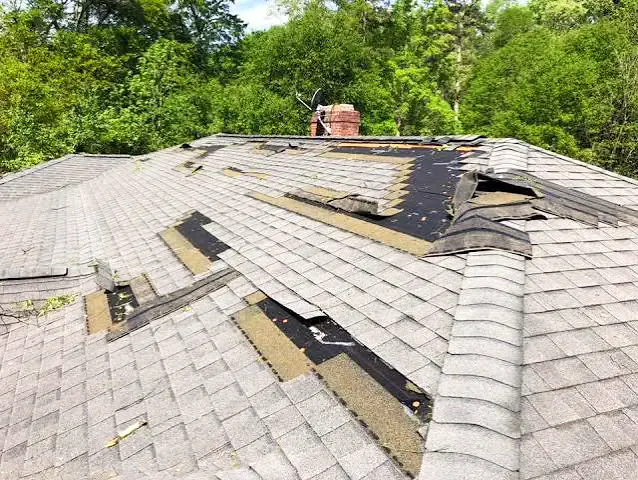
Storms in the Upstate do not damage one house, they damage a street. That has a practical consequence: after a significant wind or hail event, every roofing contractor in Greenville County is fielding calls at the same time, and the people who act in the first few hours get seen first.
It also means there is a predictable sequence that protects both your house and your claim. Work through it in order.
The short version: make it safe, photograph everything before you touch anything, notify your insurer the same day, get the roof stabilised and keep the receipt, then book a proper inspection. Do not sign anything a stranger brings to your door.
Hour one: make it safe
Before anything else, deal with what can hurt someone.
- Stay out of rooms with a sagging ceiling. Water is heavy, and a saturated section of drywall can come down without warning, taking a light fitting with it.
- Switch off circuits near water. If anything is dripping close to a ceiling light, a fan or a socket, kill that circuit at the panel rather than testing whether it is fine.
- If a ceiling is bulging, drain it deliberately. Push a screwdriver through the lowest point of the bulge into a bucket. Controlled is better than sudden.
- Do not go on the roof. Wet, storm-damaged decking can be unsupported where it looks solid. This is the single most common way homeowners are seriously injured after a storm.
- Watch for downed power lines around the property before you walk the perimeter.
Then catch the water: buckets under drips, furniture and electronics moved clear, towels down. Replace buckets before they overflow — a second soaking of the same carpet is what turns drying out into replacement.
Document before you clean up
This is the step people skip, and it is the one that costs them money later. An insurer is assessing whether damage was sudden and accidental or gradual and foreseeable. Your photographs are the evidence.
- Interior, wide then close.
Shots showing the whole room and where the damage sits, then close-ups of the ceiling, walls and any damaged contents.
- Exterior, all four elevations.
From the ground. Include the gutters, and anything lying on the lawn.
- Debris is evidence.
Shingles or tabs that blew off should go somewhere dry, not in the bin.
- Note the date, time and weather.
A written note of when you first saw water and what the weather was doing is more useful months later than people expect.
- Keep a running log.
Every call, every name, every reference number. Claims get handed between adjusters.
Tell your insurer promptly
Most policies require prompt notice, and delay is one of the most common reasons a legitimate claim gets reduced. Report it the same day if you can, even if you do not yet know the extent.
Two clauses in your own policy are worth reading before you rely on them. The first is whether roof claims settle on replacement cost or actual cash value — actual cash value deducts depreciation, which on an older roof can be substantial. The second is whether you carry a separate, higher wind and hail deductible, which is common in South Carolina and is often a percentage of the insured value rather than a flat sum.
Get it stabilised — and keep the receipt
You are generally expected to take reasonable steps to prevent further damage, and most policies cover reasonable emergency mitigation costs because preventing further damage is in the insurer's interest too.
In practice that means a properly fitted tarp or a self-adhering membrane over the affected slope, plus removing saturated insulation that would otherwise hold water against your ceiling for days. It is a holding measure, not a repair — sunlight degrades tarps, wind works at the fastenings, and every fastening is itself a hole in the roof. Our emergency roof leak repair page covers what that first visit involves.
Keep the invoice. It forms part of the claim.
Book a proper inspection
A thorough storm inspection looks at the whole roof, not just the leaking part, because a storm affects every slope. Expect a contractor to check the shingle field for creasing and broken seal strips, the hips and ridges (the most wind-exposed shingles and usually the first to go), all flashing, every penetration and pipe boot, any skylights, low-slope sections, the gutters and soft metal for hail dents, and the attic for daylight and wet sheathing.
Ask for the photographs. A written scope backed by images is far more persuasive to an adjuster than a one-line quote, and a contractor who inspects properly will have them.
One thing worth understanding: the most common wind damage is invisible from the ground. Gusts near 60 mph — the figure severe thunderstorm warnings for this area routinely cite — usually do not strip a roof. They break the self-seal strip that bonds each shingle course to the one below. The shingles stay put and look perfect, but they are no longer sealed down, so the next wind-driven rain goes underneath. A leak appearing weeks after the storm is entirely consistent with the storm having caused it.
Hail does something similar, bruising the asphalt mat beneath the granules without puncturing anything. That is why inspectors look at gutters, vents and flashing for dents — soft metal corroborates that hail of a damaging size actually fell on your property.
The door-knockers
After significant hail in the Upstate, out-of-state crews appear within days. Some are legitimate businesses chasing legitimate work. Some are not, and the warning signs are consistent.
- Pressure to sign immediately, today, before they move on
- A large deposit demanded before any work begins
- An offer to “cover” or “waive” your deductible, which is generally improper
- Vague company details, a magnetic door sign, an out-of-state plate and no local address
- Paperwork that assigns your insurance benefits to them — read this extremely carefully
Slow down. Verify the South Carolina licence through the Department of Labor, Licensing and Regulation. In this state, residential work under $10,000 falls under a Residential Specialty registration covering roofing above the deck only, while larger residential jobs and commercial roofing require a general contractor licence with a roofing classification. Ask which they hold, and ask for a current certificate of general liability and workers’ compensation insurance.
What is usually covered, and what usually is not
Policies vary and your insurer decides, but the pattern is consistent. Sudden accidental damage from a named peril — wind, hail, falling impact — is more likely to be covered. Deterioration, age and deferred maintenance are usually excluded.
The grey area is a roof that was already near the end of its life when the storm hit. Insurers argue wear; homeowners argue storm. Dated photographs, weather records for the specific event and a contractor’s written assessment are what move that argument. There is more detail on our storm damage roof leak repair page.
A realistic timeline
Day one is safety, documentation and notification. Within a few days you want stabilisation and an inspection. The adjuster visit typically follows within a week or two depending on how many claims the event generated across Greenville County. Permanent repairs happen after that, and after a widespread event they can be weeks out simply because every crew in the Upstate is booked.
That queue is the reason to call early rather than wait and see. Whether the damage turns out to be a handful of wind-damaged shingles, a lifted section of chimney flashing or something more substantial, getting into the schedule matters. One call to our Greenville roof leak repair service is enough to start it.