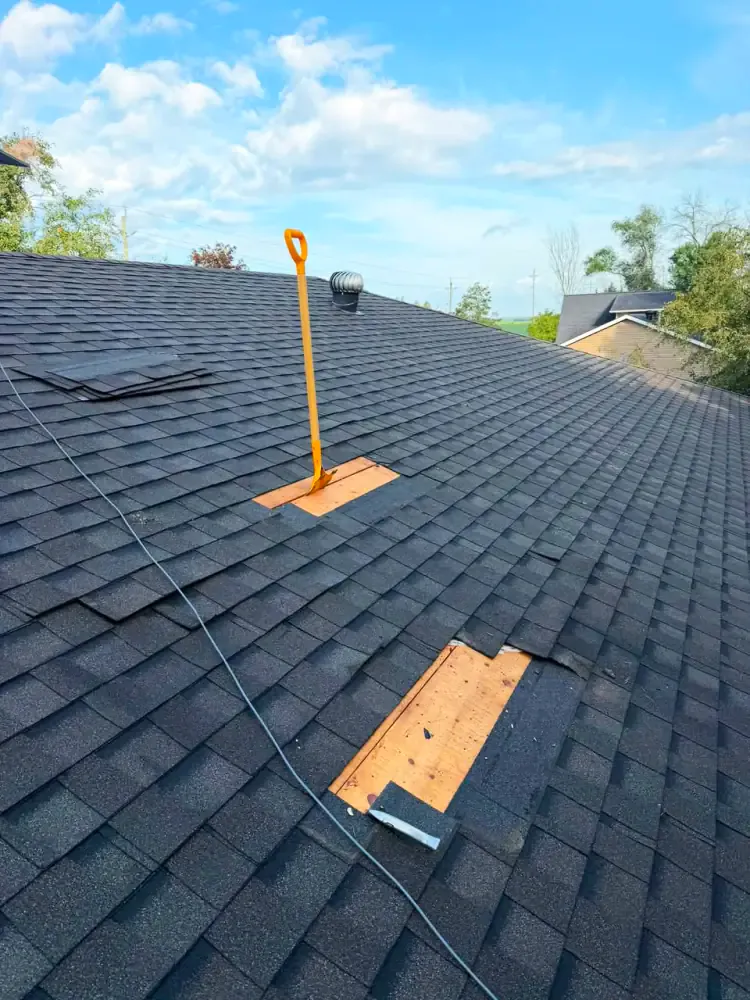
This is the single most common question we hear, and the honest answer is that it depends on evidence rather than opinion. The good news is that the evidence is not hard to understand, and once you know what to ask for you can tell a diagnosis from a pitch within about two minutes.
The short version: a roof with one failed detail and a sound covering is a repair. A roof with brittle shingles, widespread granule loss and leaks in several unrelated places is a replacement. Ask the contractor what the shingles did when they lifted them — that single answer settles most cases.
The test that settles most cases
Ask this question: “When you lifted the shingles around the damage, what did they do?”
If they flexed and went back down, the covering still has life in it and a repair is reasonable. Asphalt shingles stay pliable while the volatile oils in the mat are still present. Once those have gone, the shingle becomes brittle.
If they cracked, you have your answer. On a brittle roof every future repair causes collateral damage — the contractor breaks three shingles to replace one — and each repair becomes more expensive and less durable than the last. At that point repairs are deferring a decision rather than solving a problem.
When repair is the right answer
- The damage is localised and explainable. A few shingles off after a storm, a split pipe boot, a failed section of flashing, a skylight seal.
- The rest of the covering is in good condition. Granules intact, shingles lying flat and sealed, no widespread curling.
- The roof is comfortably within its service life and has no history of repeated leaks.
- The decking underneath is sound. No soft spots, no rot found when the area was opened.
- One cause explains all the symptoms.
Most of what we are asked about falls here. A single failed detail on an otherwise healthy roof is a repair, and anyone telling you otherwise should be able to show you why. The specific repair usually turns out to be flashing, a blocked or failed valley, or wind-damaged shingles.
When replacement is the right answer
- Granule loss across the whole roof. Sediment in the gutters, bald patches where the asphalt mat is exposed. Granules protect the asphalt from ultraviolet light; once they go, that area degrades quickly.
- Brittleness. Shingles crack when lifted.
- Widespread curling or cupping at the edges, which indicates heat ageing or chronic under-ventilation and affects the whole covering rather than one area.
- Leaks in several unrelated places in one season. Not one problem, but a covering at the end of its life.
- Deck deterioration over a wide area. Soft, spongy sheathing that no longer holds fasteners.
- Multiple layers already in place. There are limits on how many coverings a roof may carry.
The genuine grey area
There is an honest middle ground, and it is where most disagreements happen: a roof that is fifteen to twenty years old, showing its age but not obviously finished, with one real leak.
Three questions help.
How long do you intend to stay? If you are selling within two years, a sound repair and full disclosure may be the sensible commercial decision. If this is your long-term home, spending twice on repairs before replacing anyway is poor value.
Is there other work pending? If skylights are near the end of their life, replacing them during a re-roof costs far less than doing it separately later, because the flashing has to be disturbed either way. The same logic applies to ventilation improvements.
What does the attic say? A roof can look tired from outside while the deck is perfectly dry underneath — or look acceptable while the sheathing is quietly rotting. The attic is usually a better guide than the shingles.
The matching problem
Worth raising before work starts rather than after. Shingle colours get discontinued, and an existing roof has weathered and lost granules, so new material rarely blends on an older roof. On a rear slope that is purely cosmetic. On a prominent street-facing elevation it may bother you considerably.
This is a bigger consideration in Greenville’s historic districts, where a visible change of material or colour in a locally designated preservation overlay district can require design review before it happens. Houses in Hampton-Pinckney, Overbrook and Pettigru are the obvious cases — confirm the position with the City of Greenville before material is ordered.
Evidence to ask for
A recommendation should come with proof. Ask for:
- Photographs of what they found, including close-ups of the shingle condition and any decking damage
- What the shingles did when lifted — the brittleness test above
- Moisture readings or attic photographs showing the extent of any wet area
- A written scope stating what is included, what is assumed, and how additional rotten decking is priced if it is found
- The warranty position in writing, both manufacturer and workmanship
If your leak has already been “repaired” once and came back, get a dedicated leak detection visit before accepting a replacement quote. A returning leak usually means the first repair was in the wrong place rather than that the roof is finished.
Sales tactics worth recognising
- A replacement recommendation with no photographs. If they cannot show you, be sceptical.
- Urgency with no cause. “This price is only good today” is a sales technique, not a roofing assessment.
- Refusing to quote a repair at all. Some roofs genuinely cannot be repaired sensibly, but the contractor should explain why in specific terms.
- Vague scopes. “Replace roof — $X” with no detail on decking, ventilation, flashing or underlayment leaves every variation open.
- Deductible offers. An offer to absorb your insurance deductible is generally improper and tells you something about the company.
Get more than one assessment on anything presented as a replacement. It is a large purchase and a second opinion costs nothing.
What actually drives the price
We do not publish prices, because we are a referral service rather than the contractor and any figure we invented would be worse than none. What a quote is made of is knowable, though: access and pitch, how many storeys, the number of separate problems, whether the decking is sound, the covering material, how much matching matters, and whether the visit is an emergency call-out or a scheduled appointment. Interior work — drywall, paint, insulation — is usually a separate trade and a separate bill.
Whichever way your decision goes, start by finding out exactly what is wrong. Describe the symptoms and we will connect you with an independent contractor through our roof leak repair service in Greenville, SC.